

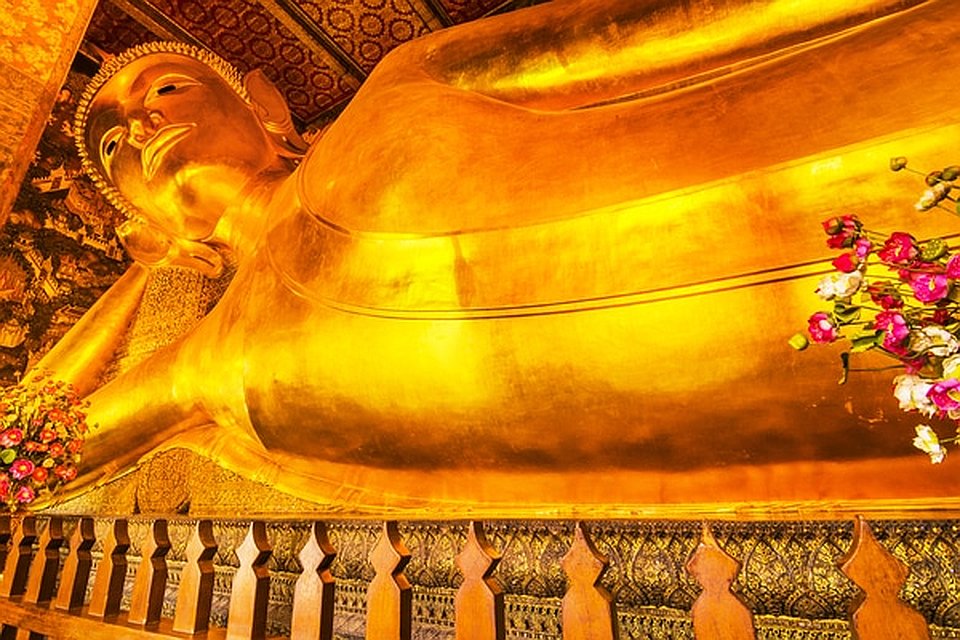
The seven Buddha postures correspond to the seven days of the week in Thai Theravada Buddhist tradition. Each posture commemorates a specific moment in the Buddha’s life and serves as the protective image for people born on that day. If you were born on a Wednesday, your posture is the alms-bowl Buddha; if you were born on a Saturday, your Buddha sits beneath the protective hood of a seven-headed Naga serpent. Here is each posture, its Thai name, what it depicts, and the personality trait associated with it.
| Day | Thai Posture Name | Posture | Significance |
|---|---|---|---|
| Sunday | Pang Thawai Net | Standing, arms crossed, right hand over left | Buddha gazing in contemplation at the Bodhi tree for seven days after enlightenment. Sunday people: kind-hearted, wise, respected. |
| Monday | Pang Ham Yati | Standing, right hand raised at shoulder, palm out | Buddha pacifying a family dispute over river water. Monday people: serious, well-travelled, exceptional memory. |
| Tuesday | Pang Sai Yat | Reclining on right side, head on right arm | Buddha humbling the demon Asura Rahu through stillness. Tuesday people: serious, active, brave. |
| Wednesday (AM) | Pang Umbat | Standing, holding alms bowl in both hands | Buddha receiving alms — granting others the merit of giving. Wednesday-morning people: artistic, polite, emotional. |
| Thursday | Pang Samti | Seated in meditation, hands resting in lap | Buddha’s final meditation under the Bodhi tree before enlightenment. Thursday people: peaceful, calm, honest. |
| Friday | Pang Ram Pueng | Standing, arms crossed at chest, right over left | Buddha contemplating the suffering of the world. Friday people: friendly, ambitious, fun-loving. |
| Saturday | Pang Nak Prok | Seated in meditation, Naga serpent canopy overhead | The Naga king Muchalinda sheltering the Buddha from a storm. Saturday people: introverted, calm, logical. |
Why I wrote this page
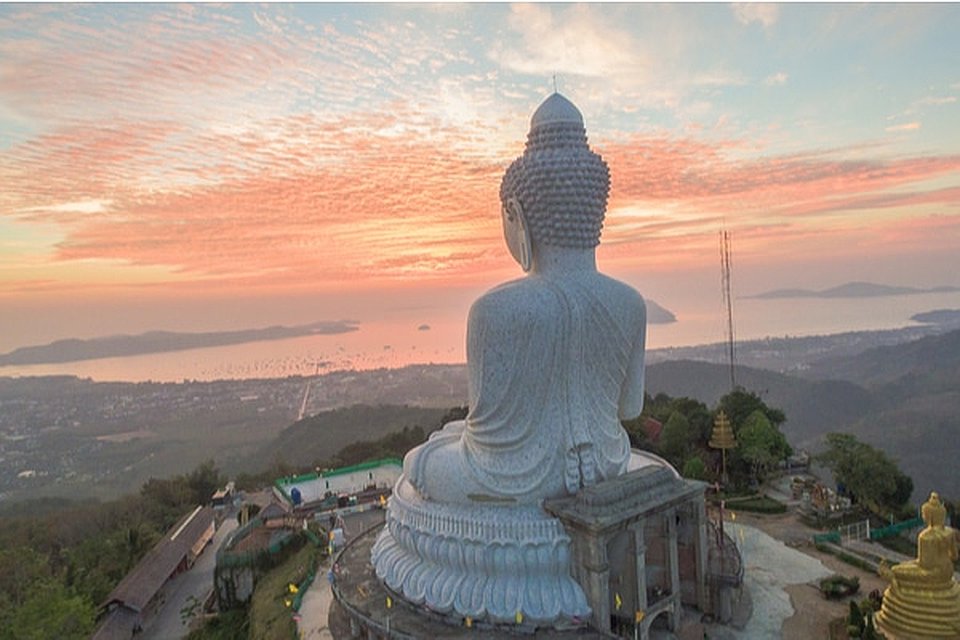
I’m Paul Chappell, owner-operator of Simba Sea Trips. We’ve been running boat tours out of Phuket since 2005 — twenty years this year — and most of those years I’ve personally been on the water with guests in the morning and back at base by mid-afternoon. The route from our base at Soho Pool Club in Boat Lagoon Marina to the southern beaches takes us past more Buddhist temples than most visitors realise: Wat Chalong, the Big Buddha of Phuket on Nakkerd Hill, Wat Phra Thong with its half-buried golden Buddha, the small wats tucked into Koh Kaew and Koh Sirey. After the boat day is done, half our guests want to spend their second day visiting at least one temple, and the question I’m asked most often — usually on the boat home — is: which posture corresponds to my birth day, and where can I see it in Phuket?
This page is the answer I give them on the boat, written down. My credibility on this is the credibility of a long-term Phuket-resident operator, not a Theravada scholar — I’ve stood in front of all seven postures at temples within forty minutes of our marina, I’ve watched our Thai crew make merit at each of them, and I’ve taken hundreds of guests through the same circuit. That’s the lens. If you want academic Theravada commentary, the books exist; if you want a working visitor’s guide that connects the postures to actual temples you can drive to from Patong or Karon in under an hour, read on.
Sunday Buddha — Pang Thawai Net (The Seven-Day Gaze)
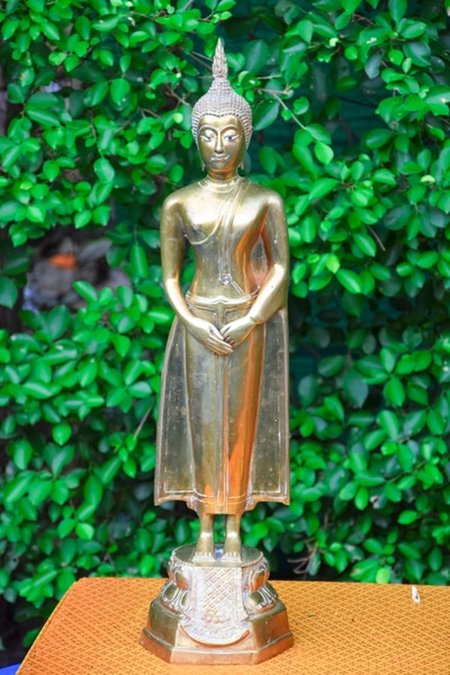
The Sunday Buddha stands upright with arms crossed in front of the body, the right hand placed over the left, eyes open in steady contemplation. The posture commemorates the seven days the Buddha spent standing in front of the Bodhi tree after his enlightenment, gazing at it without blinking in gratitude for the shelter it had given him. The Thai name Pang Thawai Net translates literally as “seven days looking.”
If you were born on a Sunday, your protective Buddha is this one, and the traits associated are wisdom, respectability, and being loved by family and friends. Sunday people are often described as the diplomats of the seven — quietly held in regard rather than loudly admired.
Where to see it in Phuket: the standing Buddha in this posture is one of the easiest to spot at Wat Chalong, Phuket’s largest and most-visited temple. As you walk through the main viharn (the temple’s prayer hall), look for the standing figure with hands crossed at the front rather than the more dramatic posture variants. Sunday people traditionally make offerings here on their birthday week.
Monday Buddha — Pang Ham Yati (The Pacification)
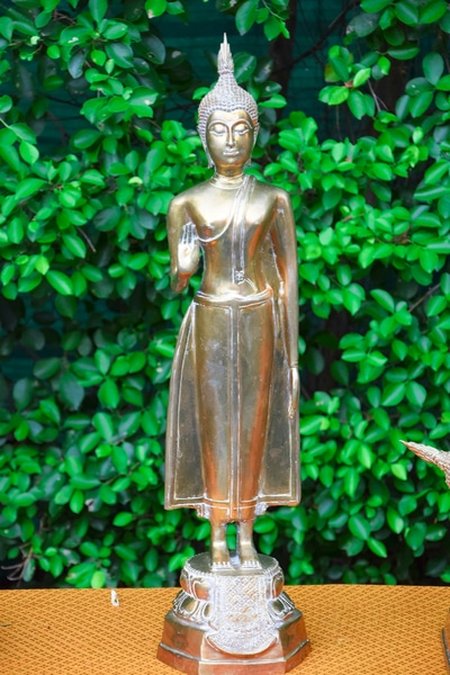
The Monday Buddha is also a standing figure, but with the right hand raised at shoulder height, palm facing outward in the abhaya mudra — the gesture of fearlessness and pacification. The story behind the posture is one of the most human in the canon: the Buddha returns from preaching in heaven for three months to find his relatives on his father’s and mother’s sides arguing over irrigation water from the Rohini river. He intervenes, talks both sides down, and brokers the compromise that saves the harvest.
People born on a Monday are said to be serious, with a love of travel and an unusually sharp memory. The traits of a peacemaker, in other words — fitting for the posture.
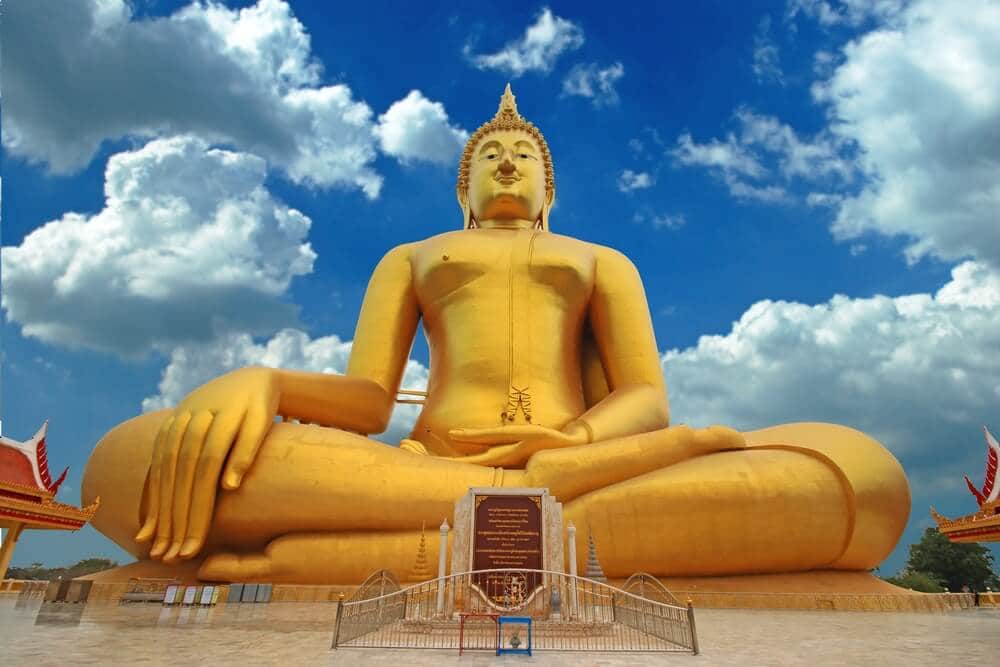
Where to see it in Phuket: the abhaya-mudra standing Buddha is the most common form across Phuket temples, present in nearly every viharn. The clearest single example is at the Big Buddha viewing terrace on Nakkerd Hill, where smaller standing Buddhas in this posture line the approach to the main 45-metre seated Buddha. Pair the visit with the panoramic view over Chalong Bay — it’s the most photographed temple stop on the island.
Tuesday Buddha — Pang Sai Yat (The Reclining Buddha)
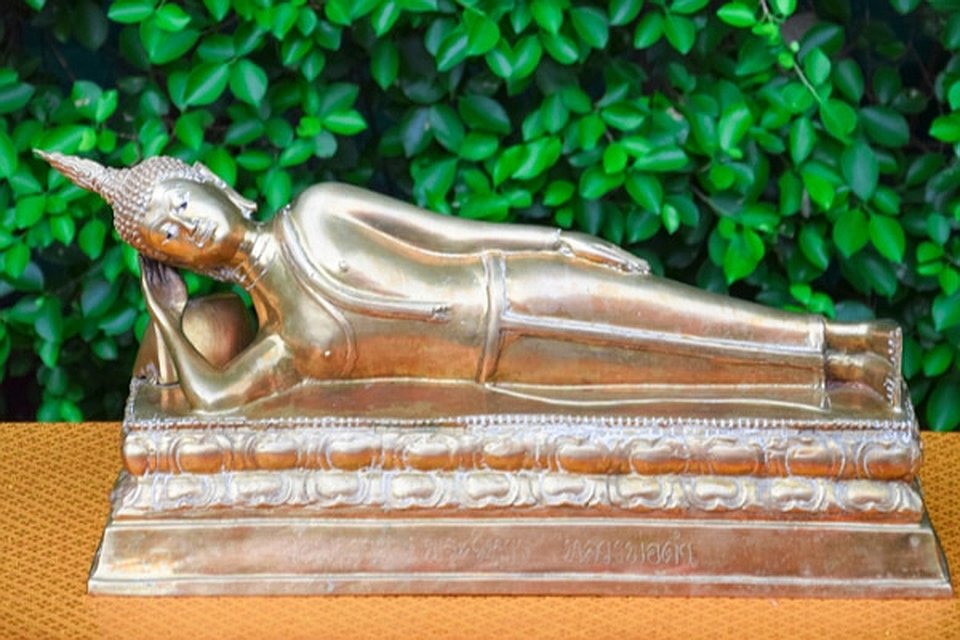
The Tuesday Buddha reclines on his right side, head resting on his right arm, toes carefully aligned. The posture commemorates the moment the Buddha humbled the demon Asura Rahu, who had refused to bow before him. The Buddha lay down in a relaxed reclining pose but appeared so vast in size that Asura Rahu, looking up, was forced to recognise the Buddha’s true magnitude and accept his teachings. The reclining posture is sometimes confused with the parinirvana (the Buddha’s final passing) — but the Tuesday Buddha is alive and teaching, not passing on.
Tuesday people are said to be serious, active, and brave — the doer’s posture.
Where to see it in Phuket: Wat Sri Sunthon in Thalang, north of Phuket town, houses one of the island’s finest reclining Buddhas — a golden figure inside a dedicated hall. Smaller reclining Buddhas can be seen at Wat Chalong’s secondary halls. For Thailand’s most famous example, you’d need to travel to Wat Pho in Bangkok (46 metres long, gold-leafed) — but the Phuket versions are closer and quieter.
Wednesday Buddha — Pang Umbat (The Alms Bowl)
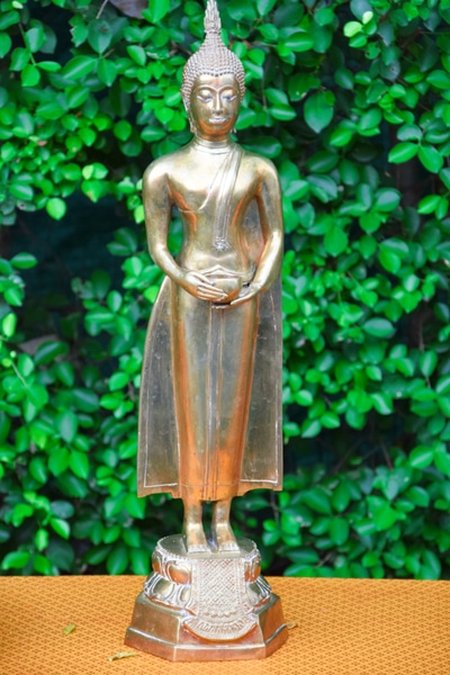
The Wednesday Buddha stands with both hands wrapped around an alms bowl held at the waist. The posture is commonly misread by visitors as a “begging” Buddha; that’s wrong. The Buddha is receiving alms — giving the donor the opportunity to make merit, which is a far more important religious act in Theravada thinking than the simple transfer of food. The alms bowl is the gift the Buddha is giving, not the gift he is asking for.
Wednesday has the unusual feature of two postures: this standing alms-bowl Buddha for the daytime hours, and the seated Pang Palelai (Buddha in the Parileyyaka forest, attended by an elephant and a monkey bringing him honey and water) for those born after dusk. Wednesday-morning people are said to be artistic, polite, and emotional; Wednesday-evening people are honest and hardworking, with a more pragmatic disposition.
Where to see it in Phuket: the alms-bowl Buddha is depicted in the murals inside the Wat Chalong ubosot (the ordination hall), and freestanding examples can be found at Wat Phra Thong in Thalang. Wat Phra Thong’s “half-buried Buddha” — a Buddha figure that emerges from the earth as if rising from below — is also worth combining into the same visit; it’s about a 30-minute drive from the airport.
Thursday Buddha — Pang Samti (The Meditation)
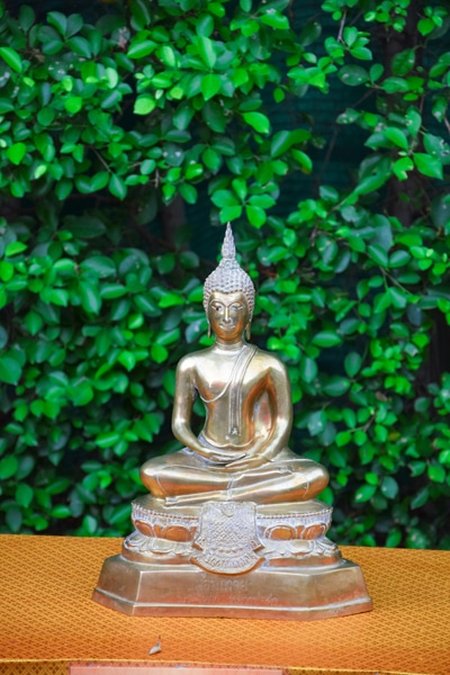
The Thursday Buddha is the iconic seated meditating Buddha: full lotus position, hands resting in the lap, palms upturned, eyes closed in concentration. This is the dhyana mudra — the gesture of meditative absorption. The posture commemorates the final stretch of meditation under the Bodhi tree before the Buddha’s enlightenment, when he had received bundles of kusha grass, arranged them as a cushion, and vowed to remain seated until awakening.
Thursday people are described as peaceful, honest, and calm — the meditator’s traits, reflected in the most settled of all the postures.
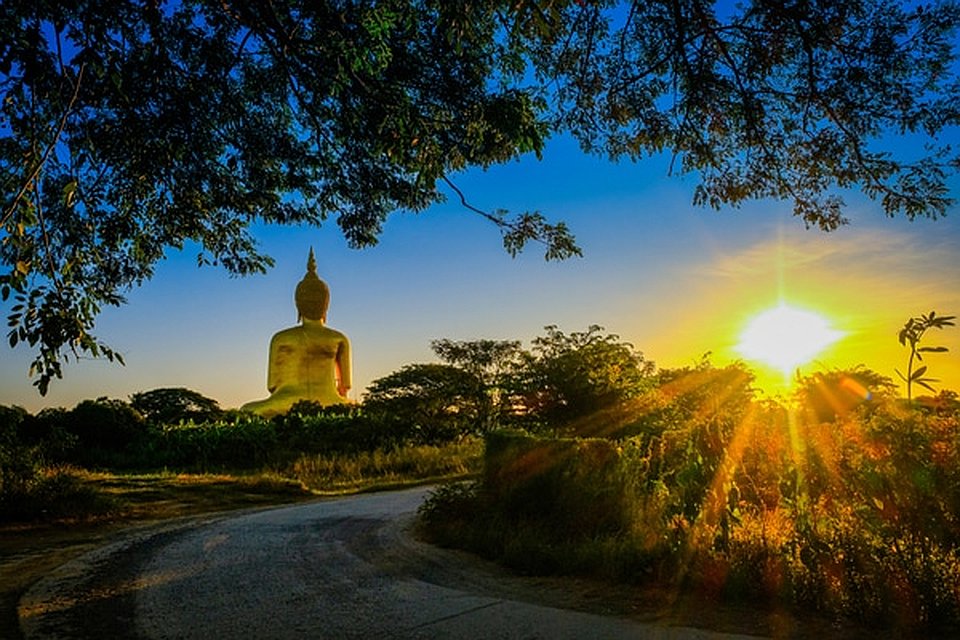
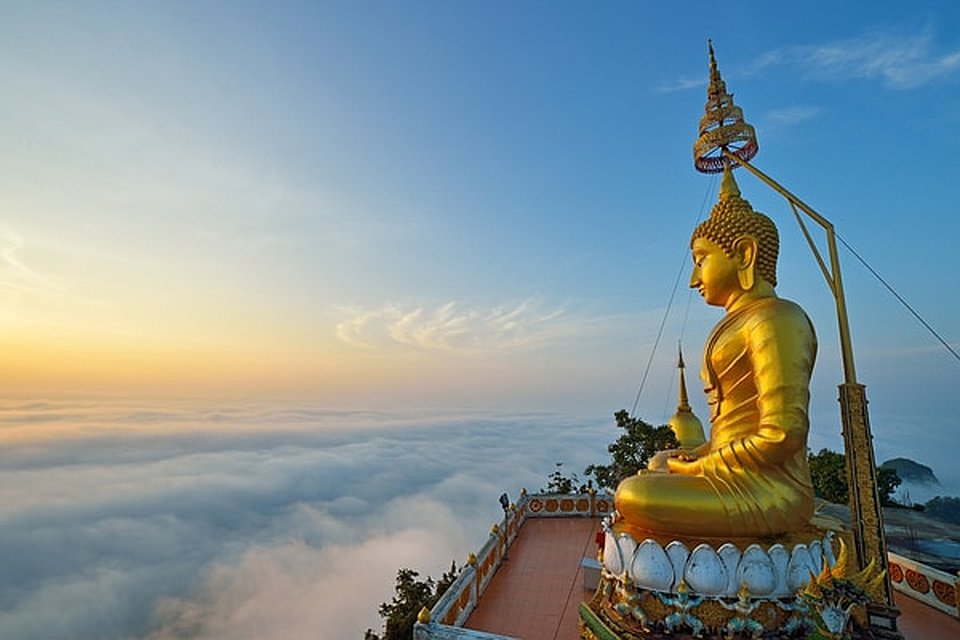
Where to see it in Phuket: the 45-metre Big Buddha of Phuket on Nakkerd Hill is the island’s largest and most photographed example — visible from much of central Phuket, and the seated meditating Buddha par excellence. The drive up the hill from Chalong is about 20 minutes; the views from the platform over the southern coast are worth the trip on their own. Smaller meditating Buddhas are present in every Phuket temple — it’s the most common single posture in Thai Buddhism.
Friday Buddha — Pang Ram Pueng (The Contemplation)
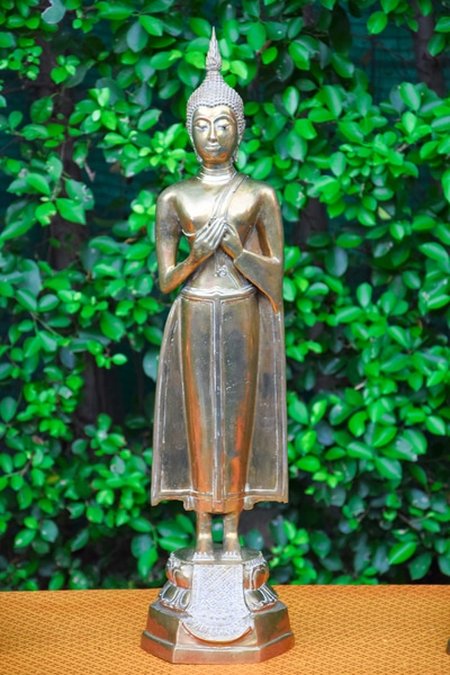
The Friday Buddha stands with arms crossed at the chest, the right hand over the left, eyes open in contemplation. The pose is similar to the Sunday standing Buddha but with the arms held higher — at the chest rather than the abdomen — and the meaning is different. The Sunday posture is gratitude toward the Bodhi tree; the Friday posture is the Buddha contemplating whether the world is ready to receive his teaching after his enlightenment. It’s a moment of doubt resolved into determination.
Friday people are said to be friendly, ambitious, and fun-loving. They are also disproportionately likely to be entertainers and public figures — though I’d take that part of the tradition with a smile.
Where to see it in Phuket: look for the chest-crossed standing Buddha at Wat Chalong’s main viharn, particularly on the right side as you face the central altar. The Friday posture is less common than the Sunday or Monday standing forms, so it’s worth specifically asking the temple staff if you want to find a clear example — they’re used to the question.
Saturday Buddha — Pang Nak Prok (The Naga Shelter)
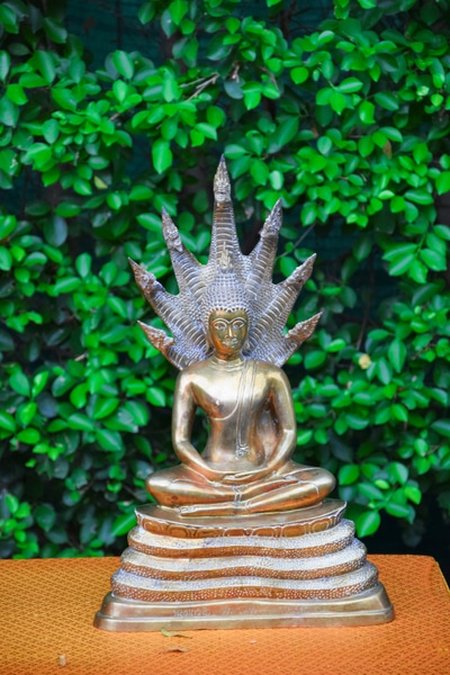
The Saturday Buddha sits in full lotus position, but with a seven-headed Naga serpent rising behind him, its hood spread protectively over his head. The story is one of the most visually distinctive in the canon: in the week following his enlightenment, a sudden storm broke over the meditating Buddha, and the Naga king Muchalinda emerged from beneath the earth, coiled his body underneath the Buddha to lift him above the rising water, and spread his multi-headed hood as a roof against the rain. When the storm passed, Muchalinda transformed into a young man and bowed.
Saturday people are described as introverted, calm, and logical — the strategist’s traits. It is also, I’d add, the most striking of the seven postures visually; the multi-headed Naga makes it impossible to mistake for any other.
Where to see it in Phuket: Wat Phra Thong and Wat Chalong both house good examples of the Naga-sheltered Buddha. If you’re combining a temple visit with a boat day, our Phi Phi Sunrise Tour returns to Boat Lagoon Marina by mid-afternoon, and Wat Chalong is a 25-minute drive south. Plenty of guests do both in one day.
Visiting Phuket’s temples — practical etiquette
Thai Buddhist temples are active places of worship, not museums, and the dress and behaviour codes matter. Here is the working visitor’s checklist I give our guests on the boat:
- Cover shoulders and knees. This is non-negotiable at the more important temples (Wat Chalong, Big Buddha) — sleeveless tops and short shorts will be refused entry. Wat Chalong’s small souvenir kiosks rent sarongs and shawls if you arrive unprepared.
- Remove shoes before entering any building. Walking on the floor of a viharn or ubosot in shoes is the single biggest faux pas Western visitors make. Watch what locals are doing at the entrance — there will be a sea of footwear.
- Never point your feet at a Buddha image. When seated, fold your legs to one side or sit cross-legged — never with feet extended toward the altar. Feet are considered the lowest part of the body in Thai culture; the head and the Buddha image are the highest.
- Don’t touch the statues. Photographs are fine in nearly all temples, but keep a respectful distance and don’t climb on, lean against, or pose with the figures.
- Make merit, don’t bargain. Donations to maintain the temple are appreciated; the small offerings (lotus flowers, gold leaf, incense) sold at temple entrances are inexpensive and the right gift to bring.
Buying amulets: Wat Chalong has stalls selling authentic amulets blessed by the temple monks; these are the ones to look for if you want a real Phuket-temple amulet rather than a tourist piece. Authentic amulets are generally inexpensive (50-300 THB for common designs) and come with a small printed card noting the blessing. The expensive amulets sold to tourists in beach-resort shops are nearly always tourist pieces with no temple provenance.
If you’re visiting Phuket and want to combine a temple circuit with a day on the water, our morning Phi Phi tour and our afternoon Phang Nga Bay tour both return to Boat Lagoon Marina by mid-afternoon — Wat Chalong is a 25-minute drive south, and the Big Buddha viewing terrace is another 15 minutes from there. Most of our guests do the boat day first, then take it slow with a temple visit the following morning before flying out. Browse our full tour calendar to plan the timing.
Browse our tour calendar — trusted by 5,900+ verified reviewers across TripAdvisor, Google & GetYourGuide.