

Thai food has always been shaped by everyday life. People cooked with what was around them and what made sense at the time. The land, the climate and home cooking mattered more than presentation or rules.
Rice from the central plains became a staple because it was available and filling. Spices arrived through trade because people travelled and exchanged goods. Ingredients were used because they worked for how people lived and ate.
Over centuries, influences from China, India, the Khmer world, Persia and Portugal made their way into local kitchens. None of them replaced what was already there. They were adjusted, tested and slowly folded in. Some stayed, some didn't.
This guide walks through how Thai food developed, where each influence came from, and where you can still taste that history today, including here in Phuket, where the island's own food culture is one of the best examples of that mixing.
How Thai Cuisine First Took Shape
Thai food as we know it didn't appear overnight. Its roots go back hundreds of years, shaped by geography, migration and farming. Rice has always been at the centre of the Thai meal, and the fertile central plains made it the backbone of the diet. Freshwater fish, herbs and vegetables made up most of the early table, with meals built around balance rather than excess.
People moved around the region a lot, and ideas moved with them. Early Thai kingdoms such as Sukhothai and later Ayutthaya sat on busy trade routes, so outside influences kept showing up in everyday life, food included.
Ingredients like coconut milk, lemongrass and galangal became part of the cooking gradually, used where they made sense. Cooks didn't change their food completely. They adjusted it, a little at a time.
How Other Cultures Shaped Thai Cuisine Over Time
Thai cuisine didn't develop in isolation. As people travelled, traded and settled across the region, their food traditions came with them and blended with local ingredients and habits.
Chinese Influence on Thai Cuisine
Chinese influence is one of the most visible in Thai cooking. Stir-frying in a wok and many noodle dishes came with Chinese immigrants, who settled in large numbers over several centuries.
Dishes like pad see ew and kuay teow noodle soup grew out of these traditions and were adapted to Thai tastes. Soy sauce, tofu and pickled vegetables entered Thai kitchens the same way. What started as borrowed methods became everyday Thai cooking.
Indian and Persian Influences
Trade with India brought dried spices such as cumin, turmeric and coriander seed, which found their way into curry pastes and gave some dishes extra warmth and depth.
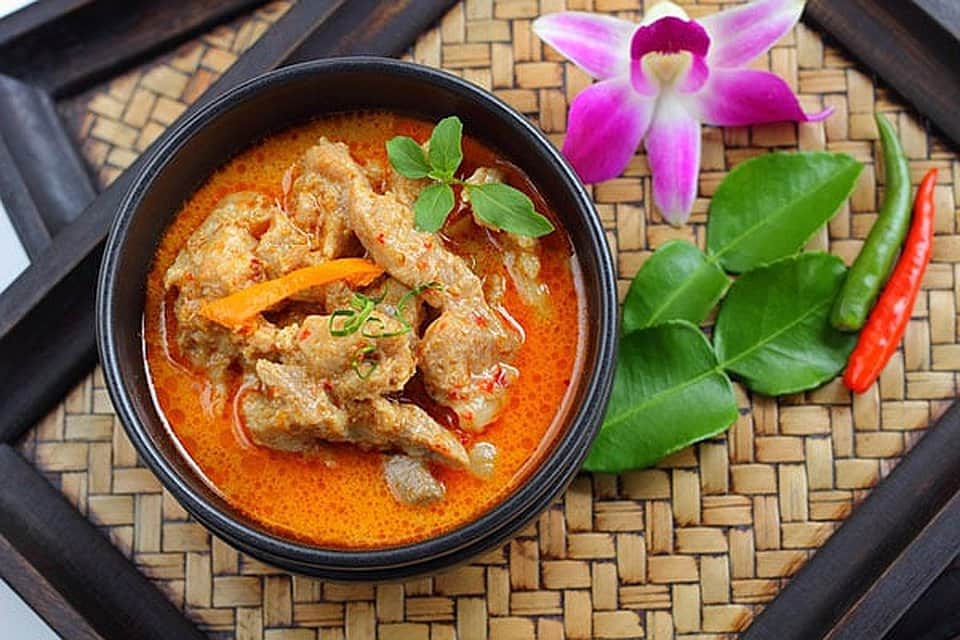
Muslim and Persian traders and courtiers at Ayutthaya left their mark too. Massaman curry is the clearest example: dried spices, potatoes and a rich, mildly sweet sauce, made with Thai ingredients and Thai technique. Its name is generally traced to an old word for "Muslim".
Khmer Influence on Thai Cuisine
The Khmer Empire dominated much of the region before the rise of the Thai kingdoms, and the two cultures shared a great deal, from language and court customs to food. Pounded herb pastes and the pairing of aromatics like galangal and lemongrass are common to both kitchens today, which is part of why Thai and Cambodian food feel closely related.
Portuguese Influence on Thai Cuisine
The Portuguese reached Siam in the early 16th century, and some of what they brought stayed. The best-known legacy is a family of egg-yolk and sugar sweets. Thai cooks adapted them into desserts like foi thong (golden threads) and thong yod (golden drops), which are now served at weddings and merit-making ceremonies rather than thought of as foreign recipes.
Chillies and the Age of European Trade
Thailand was never colonised, but European trade still changed its kitchens. From the 16th century, Portuguese and later Dutch traders were part of the Ayutthaya trade network, and through that network came chillies, originally from the Americas.
Before then, Thai cooking got its heat from peppercorns and other spices. Chillies caught on, then took over. Today it's hard to picture a green curry or a som tam papaya salad without them, yet they've only been part of Thai food for a few hundred years.
That's the pattern of the whole cuisine. New ingredients arrived, Thai cooks tried them, and the ones that worked became Thai.
Modern Thai Food
By the late 1800s and early 1900s, Siam was more connected to the outside world than ever, and its kitchens kept changing. Pad thai, now the dish most visitors order first, is a good example. It was popularised as a national dish in the late 1930s and 1940s, during a government campaign to promote Thai identity, and it borrowed its stir-fried rice noodles from Chinese cooking.
Thai food keeps adapting today, while still being built on the same things it always was: rice, fresh herbs and a balance of sour, salty, sweet and spicy.
Phuket's Own Food History
Phuket is a good place to see this mixing up close. In the 19th century, the island's tin-mining boom drew Hokkien Chinese workers and traders, many of whom married into local families. The Peranakan (Baba) culture that grew out of that still shapes the food in Phuket Town: mee hokkien noodles, moo hong braised pork belly, o-tao oyster and taro omelette, and dim sum breakfasts that locals still queue for.
Southern Thai cooking is also hotter and more turmeric-heavy than food from central Thailand, with dishes like kaeng som sour curry and dry-fried kua kling. In 2015, UNESCO named Phuket a Creative City of Gastronomy, in recognition of this mix of Chinese, Peranakan, Muslim and southern Thai food traditions.
Eating Well Between the Islands with Simba Sea Trips
Our tours are built around the sea, but food is part of the day. On the Phi Phi Sunrise Tour, a light breakfast is included, and after the island and snorkelling stops the day finishes with a buffet lunch back at Soho Pool Club, our base at Boat Lagoon Marina. The Coral Delight private charter also ends with lunch at Soho after a morning of snorkelling around southern Phuket's quieter islands.
Head north-east instead and lunch moves to the islands. Our Phang Nga Bay tour, along with the Phang Nga Bay and Krabi private charters, stops for lunch at a beachfront restaurant between the limestone islands. It's a Thai meal with the sea right beside the table, which is the setting a lot of this food grew up in.
Groups are capped at a maximum of 18 adults, so the day stays relaxed. If you'd like the boat to yourselves, see our private charters, or browse all our join-in boat tours from Phuket.
Before or after your trip, take an evening in Phuket Town to taste the island's Peranakan dishes for yourself. It's one of the best ways to see how much history sits on a single Thai plate.